Holding Trucking Companies Accountable in Florida & Kentucky
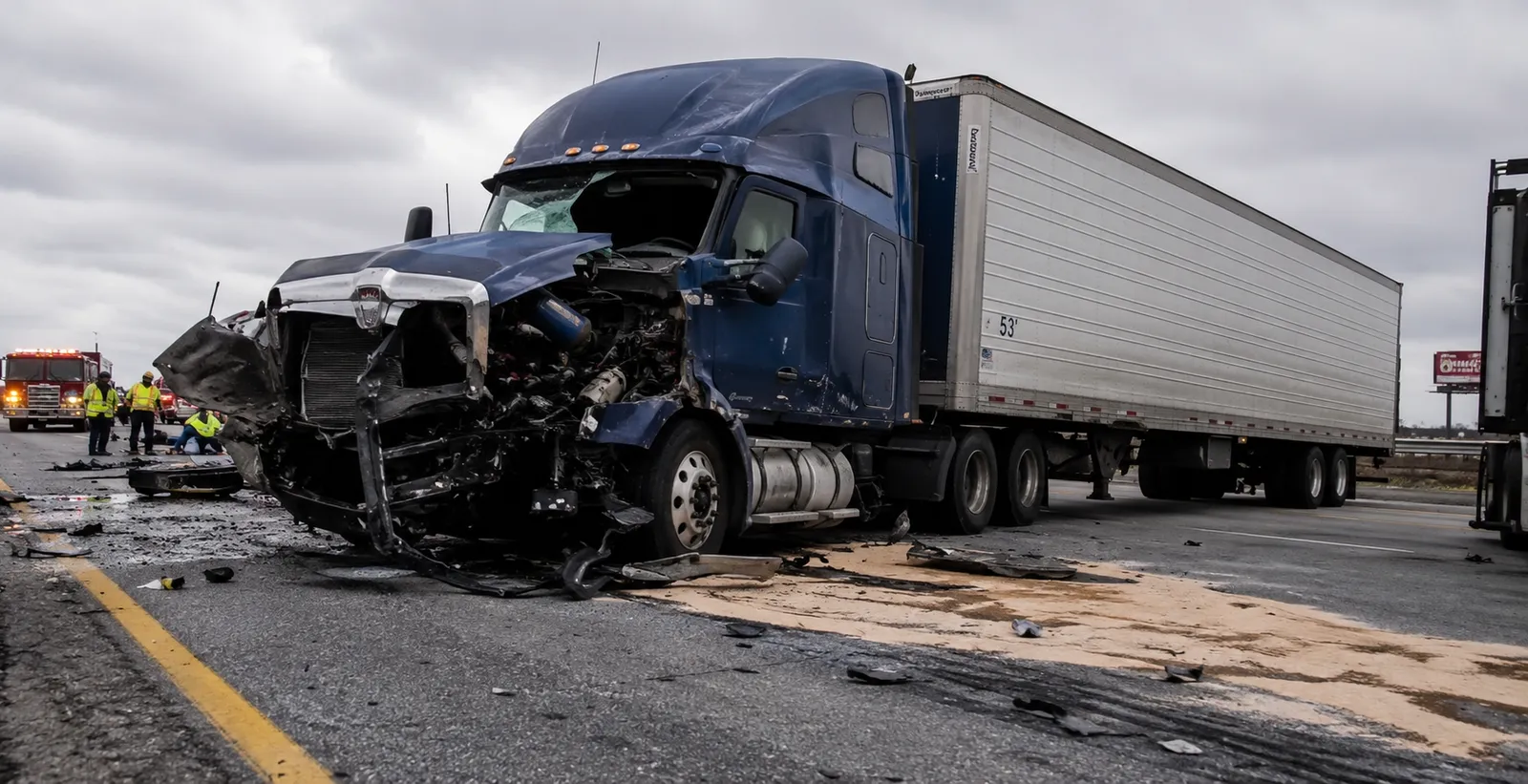
When an 80,000-pound tractor-trailer collides with a 4,000-pound passenger car, physics decides who gets hurt — and it is almost never the trucker. The people in the smaller vehicle absorb forces that produce life-altering injuries: traumatic brain injuries, spinal cord damage, crushed limbs, internal bleeding. If you or a family member has been struck by a semi, box truck, tanker, or other commercial vehicle in Florida or Kentucky, the road ahead can feel overwhelming. Adam Clark Law exists to carry that weight for you.
Trucking litigation is not car-wreck litigation on a bigger scale; it is a different discipline. The industry operates under the Federal Motor Carrier Safety Regulations, a dense body of federal law covering how many hours a driver may work, how cargo must be loaded and secured, how often equipment must be inspected, who is qualified to hold a commercial driver’s license, and when drug and alcohol testing is required. Every one of those requirements generates records — driver qualification files, inspection reports, maintenance histories, ELD downloads — and every violation buried in those records is a thread we can pull to expose what really caused the crash.
The most common thread is fatigue. FMCSA hours-of-service limits cap driving at 11 hours within a 14-hour on-duty window, yet delivery schedules and pay-per-mile compensation push drivers to stretch those limits. Others involve maintenance shortcuts: brakes out of adjustment, bald tires, broken underride guards. Still others trace back to the hiring desk, where a carrier put an unqualified or repeatedly cited driver behind the wheel because freight needed to move. Our job is to find the failure, document it, and connect it to the company policies that allowed it.
Evidence is the battleground in these cases, and it disappears quickly. The tractor’s engine control module holds speed and braking data from the final seconds before impact. The electronic logging device shows exactly how long the driver had been on duty. Dashcams, dispatch communications, weigh-station records, bills of lading, and post-crash inspection reports all tell pieces of the story. Motor carriers know retention schedules allow certain records to be destroyed in the ordinary course of business — which is why one of the first things we do is serve a preservation demand that legally obligates the carrier to keep everything.
Expect the trucking company’s insurer to be organized, well-funded, and unsympathetic. Rapid-response teams are often rolling toward the crash scene while victims are still in the emergency room. Adjusters may call within days offering a quick check, hoping to close the file before the full extent of your injuries — or the carrier’s regulatory violations — comes to light. You do not have to talk to them, and you should not sign anything until someone who answers only to you has reviewed it.
Adam Clark Law represents truck crash victims and grieving families throughout Florida and Kentucky. We retain accident reconstructionists, trucking-safety experts, and medical professionals to build a complete picture of liability and lifetime damages. We pursue every layer of responsibility — driver, carrier, shipper, broker, maintenance vendor — and every available insurance policy. And because we work on a contingency-fee basis, you owe nothing unless we recover for you.
The consultation is free, confidential, and carries no obligation. If a commercial truck turned your life upside down, let us shoulder the legal fight while you focus on healing.
After a commercial truck crash, take these four steps to protect your claim:
- Report and get treated: Call 911 from the scene so law enforcement documents the wreck, and accept or seek medical evaluation the same day. Commercial vehicle crashes frequently trigger detailed police investigation — that report, and your early medical records, become cornerstones of the claim.
- Capture what the scene will not preserve: If you are physically able, photograph the truck’s USDOT number, license plates, trailer placards, the positions of the vehicles, skid marks, debris fields, and your injuries. Write down the driver’s name, employer, and insurance details, plus contact information for every witness.
- Decline recorded statements: The carrier’s insurance representatives may reach out quickly and sound helpful. Politely refuse to give a recorded statement or sign medical authorizations until you have counsel — those tools are designed to shrink your claim.
- Get a lawyer moving on preservation: Text or call Adam Clark Law at (386) 264-4495. The sooner we are retained, the sooner spoliation letters go out demanding the ELD data, black-box download, driver logs, and maintenance files that prove what happened — before any of it can vanish.