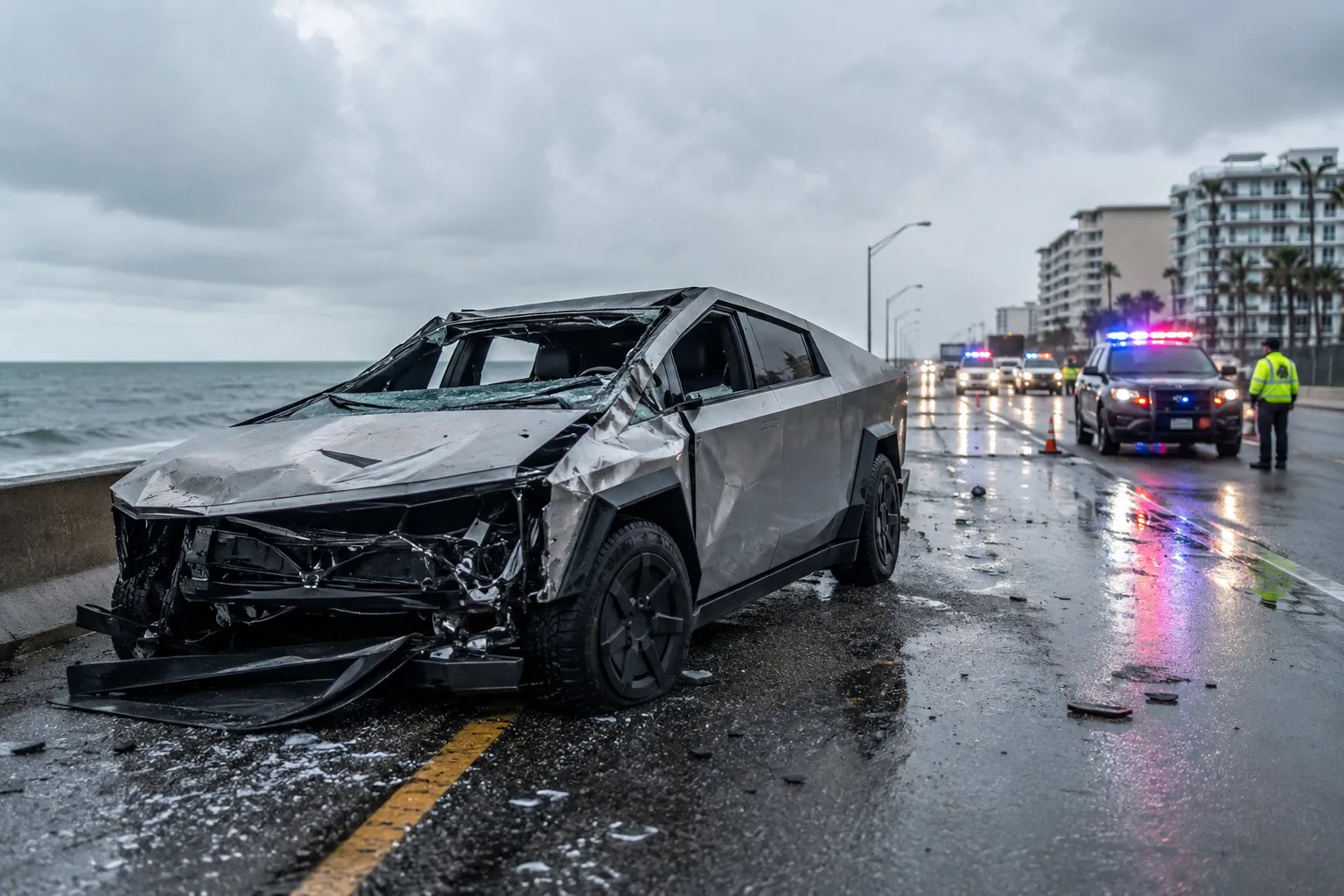
Tesla & Cybertruck Accidents

Tesla & Cybertruck Accident Lawyer

Tesla & Cybertruck Accidents - Adam Clark Law

When the Crash Involves a Tesla, the Evidence Is Digital — and It Will Not Wait

Teslas are everywhere on Florida roads, and the Cybertruck — more than three tons of stainless steel — is no longer a rarity. When one of these vehicles is involved in a serious crash, two things separate the case from an ordinary wreck: the physics of the collision and the evidence it leaves behind. If you or someone you love has been hurt in a crash involving a Tesla or Cybertruck, Adam Clark Law understands both.

In 2026, our firm, on behalf of a family that included a 16-year-old girl who was tragically injured in a crash involving a Cybertruck, achieved a $2.05 million maximum-limits settlement — less than one month after the crash. A maximum-limits settlement means the insurer paid everything the policy allowed — and resolving it in under a month spared that family years of litigation. That is what we mean when we say the firm is client-focused, gives personalized attention, and keeps its knowledge of the medicine and the technologies involved in these crashes up to date: those are working methods, and this is what they produced. Every case turns on its own facts, and no result is guaranteed.

Every Tesla is a rolling data recorder. The event data recorder captures speed, throttle, braking, and restraint use in the seconds around impact. Telemetry streams to Tesla’s servers document whether Autopilot or Full Self-Driving was engaged, what the system perceived, and how the driver responded to alerts. Sentry Mode and the vehicle’s external cameras may hold video of the collision itself; the cabin camera can bear on driver attention. Even the software version is evidence, because over-the-air updates mean the car that gets inspected next month may not behave like the car that crashed. We move immediately to secure all of it — including preservation letters to Tesla that legally obligate the company to retain the data — because footage gets overwritten, vehicles get salvaged, and software gets updated.

The physics deserve equal attention. A Cybertruck’s curb weight is roughly 6,600 pounds, and its rigid stainless-steel exoskeleton does not crumple the way conventional vehicles are engineered to. In a collision, energy that a softer structure would absorb is instead delivered to the lighter vehicle — or to the pedestrian or cyclist — on the other side of the impact. Add an electric powertrain that produces maximum torque the instant the accelerator is pressed, and you have a vehicle class that turns small driving errors into catastrophic injuries. Reconstructing these crashes credibly requires engaging with that engineering, and we do.

Courts around the country are now testing how these design realities translate into legal responsibility. In 2025, a federal jury in Miami returned a $243 million verdict against Tesla in a case arising from a fatal crash involving Autopilot. Product-liability suits filed after a fatal Cybertruck fire in Piedmont, California allege that electronically actuated doors and a battery fire prevented occupants from escaping. Those are other families’ cases, brought by other lawyers — we cite them because the engineering issues they surface, from driver-assistance overreliance to battery fires to door egress, inform how we investigate and value the cases that are ours.

Most crashes involving a Tesla, of course, come down to the same negligence that causes every other wreck: speeding, distraction, following too closely, a driver trusting software to do a human’s job. What changes is the proof available. Where an ordinary case leans on witness memory and skid marks, these cases can be built on time-stamped data and video — if someone acts fast enough to capture them. That is the heart of what we offer: we know what evidence exists, where it lives, who controls it, and how to demand it before it disappears.

Adam Clark Law represents people injured in crashes involving Teslas and Cybertrucks throughout Florida, as well as in Kentucky. The consultation is free, confidential, and carries no obligation, and we handle these cases on contingency — no fee unless we recover for you.

After a crash involving a Tesla or Cybertruck, these four steps protect you:

  1. Get medical care immediately: The forces in these collisions are severe, and adrenaline masks injuries — internal trauma and concussions often declare themselves hours later. Let EMS evaluate you at the scene and follow up with a physician the same day so your injuries are documented from hour one.
  2. Record what the data will need: If you are able, photograph the vehicles, license plates, scene, and your visible injuries, and write down the exact time and location — telemetry and camera footage are time-indexed, and precision helps us match the data to the crash. Note nearby homes and businesses whose cameras may have caught the collision.
  3. Say little, sign nothing: Give the responding officer the facts, then stop discussing fault — especially with any insurer. Do not give a recorded statement or sign authorizations until someone who answers only to you has reviewed them.
  4. Get preservation moving: Text or call Adam Clark Law at (386) 264-4495. Early involvement lets us send preservation letters to Tesla and the insurers, demand the EDR and telemetry downloads, secure Sentry Mode footage before it is overwritten, and pin down the software version before an over-the-air update rewrites it.


Locations

Adam Clark Law services clients across Kentucky and Florida. See all of our office locations below.

ServingDaytona Beach, New Smyrna Beach, Palm Coast

Frequently asked questions

Your Questions Answered: Guidance on Tesla & Cybertruck Accidents

What makes a crash involving a Tesla or Cybertruck different from an ordinary car accident?
Two things: the evidence and the physics. A Tesla continuously records how it is being driven — speed, steering, braking, and whether Autopilot or Full Self-Driving was engaged — and its cameras may hold video of the crash itself. That record can prove exactly what happened, but much of it lives in vehicle systems and on Tesla's servers, where it can be overwritten or changed by an over-the-air software update. The vehicles also behave differently in a wreck: a Cybertruck weighs roughly 6,600 pounds and is built around a rigid stainless-steel exoskeleton, so the forces it transmits to a lighter car, a cyclist, or a pedestrian are severe. Handling these cases well means understanding both the data and the engineering.
What data does a Tesla record, and how can it help my claim?
A great deal. The event data recorder captures speed, throttle position, braking, and seatbelt status in the seconds surrounding a collision. Vehicle telemetry logs whether driver-assistance features were active and how the driver responded to warnings. Sentry Mode and the car's external cameras may have recorded the crash from multiple angles, and the interior cabin camera can bear on driver attention. Even the software version matters, because a Tesla's behavior can change from one over-the-air update to the next. Obtained and interpreted correctly, this evidence replaces guesswork and conflicting memories with a time-stamped record of the truth.
The Tesla that hit me was on Autopilot or Full Self-Driving. Who is responsible?
The driver, first and always: Autopilot and Full Self-Driving are driver-assistance features that require an attentive human, and overreliance on them does not excuse a driver who fails to avoid a crash. Whether responsibility extends further depends on the facts and the data. Courts are actively testing that question — in 2025, a federal jury in Miami returned a $243 million verdict against Tesla in a case arising from a fatal crash involving Autopilot. That was another family's case, not ours, but it shows why the logs matter: what the system saw, what it did, and what the driver was told are all recorded, and they determine who can be held accountable.
Why does the Cybertruck's design matter to my injury claim?
Because crashes obey physics. At roughly 6,600 pounds, a Cybertruck outweighs most passenger cars by thousands of pounds, and its stainless-steel exoskeleton is far more rigid than conventional body panels engineered to crumple and absorb energy. In a collision with a lighter vehicle, that combination pushes more of the crash energy into the other vehicle — and the people inside it. Electric powertrains also deliver their full torque instantly, so these vehicles reach dangerous speeds in very little distance. Those engineering realities shape how injuries happen, how a crash must be reconstructed, and how a claim should be valued.
What about battery fires and doors that will not open?
Both are live issues in litigation around the country. Lithium-ion battery packs can ignite after a significant impact and can be extraordinarily difficult to extinguish. The Cybertruck's doors are electronically actuated, with manual releases that occupants may not find in an emergency. Product-liability lawsuits filed after a fatal Cybertruck fire in Piedmont, California — cases brought by other families, not by our firm — allege that door egress and battery fire played a role in the deaths. When fire or a blocked escape contributes to injuries, those design questions can become part of the case, and preserving the vehicle before it is scrapped becomes critical.
How quickly do I need to act to preserve Tesla evidence?
Immediately. Sentry Mode and dashcam footage can be overwritten in the ordinary course of the vehicle's operation. Telemetry and Autopilot logs largely reside on Tesla's servers and must be requested through proper channels. An over-the-air update can change the vehicle's software from what it was on the day of the crash, and a totaled vehicle can be sold for salvage before anyone downloads its data. One of the first things we do is send preservation letters — to Tesla, to the owners of the vehicles, and to the insurers — that legally obligate everyone to keep the evidence intact. The window for doing that is measured in days, not months.
Has Adam Clark Law actually resolved a case involving a Cybertruck?
Yes. In 2026, on behalf of a family that included a 16-year-old girl who was tragically injured in a crash involving a Cybertruck, our firm achieved a $2.05 million maximum-limits settlement — less than one month after the crash. Every case turns on its own facts, and no past result guarantees a future outcome. What that result reflects is a way of working: client-focused representation, personalized attention, and up-to-date knowledge of the medicine and the technologies involved in these crashes.

Let’s Get Started

(386) 264-4495
(386) 264-4495
adam@adamclark.law
OR
Simply complete the form below and please be as detailed as possible so that I can understand your problem.